We walked together as is our wont on a Sunday. The sun came out. It was unexpected, and lovely. The steam train was just about to leave the station and we waited for it to come past, the vapour from its shiny engine billowing around our legs. I felt like a child filled with glee at being in the presence of something marvellous. A little girl with a hair band festooned with Union Jacks waved at us as the carriages trundled away. Turning down the path alongside the river I saw a Small Blue butterfly sunning itself on a leaf. Another marvel. I was filled up.
I finally got round to listening and watching Joan Halifax’s TED talk on Youtube. She is a rousing and spine-tingling speaker. Every so often she stops talking, places her hands in a position of prayer and raises them to her mouth. No doubt gathering her thoughts and perhaps praying for guidance. She talks about compassion as an active feeling, as an emotion that is not about pity or moral outrage but one that moves within us so as to heal. She quoted the Buddhist notion of a hard back and a soft front, of keeping your heart open to life, to others but remaining grounded, centred in oneself. I need to learn this. The suffering of others touches me deeply but I am of no use if I am weighed down or hobbled by their pain. I want to actively sit with it, witness it but still be able to be strong and vital so that I can offer clean, pure light-filled healing. She put it all so eloquently. I cannot. Help me to do some good, in whatever small way I can. Not as a stroke to my ego, but a genuine detached, non-self goodness.
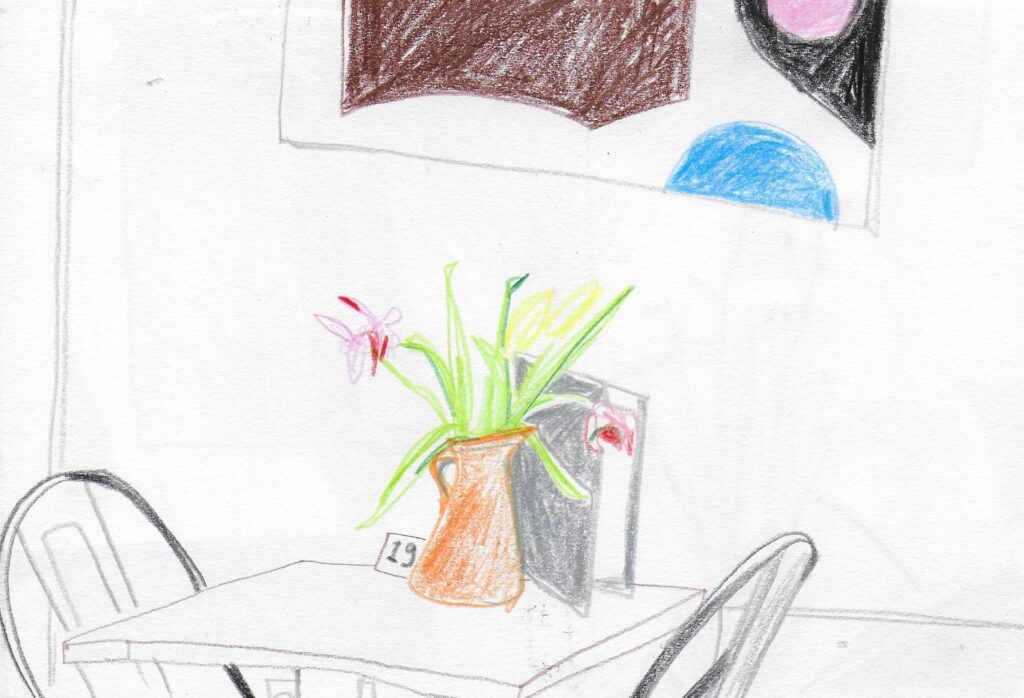
The Carlton Cafe is to close. He read about it in the local paper. It is sad. He’s known the owner for a long time, from when she used to be a waitress in a restaurant he and his mother were fond of. She and her partner worked so hard to make the cafe nice. The food wasn’t wonderful but is was filling, and of the kind of fare that the sort of holidaymakers that come here wanted. The portions were generous, with plates piled high with chips, beans or roast potatoes. Milk shakes came in the tall, fluted glasses that I remember knickerbocker glories being served in as a child. Builder’s tea was delivered in little metal pots, and coffees were weak but milky. And there were the banquettes. You could look down on the high street below from them. And there were always help-yourself tins of hair and body spray and tubes of hand cream in the ladies loo. She cared, as did he. The lockdown, Brexit and the cost of living have all taken their toll. I shall miss it. And them.
I never set out on my early walk with pleasure these days. It’s a sad fact, but it is true. It’s the beginning that’s the hardest. The loss of cartilaginous cushioning in my hips makes my legs stiff, unyielding, unwieldy, I walk with a limp and a lean. It is graceless. I will myself to go faster but my body refuses. It does improve the further I get, and by then I am taken over by the gorgeous smell of the morning air, the sound of bird song, the lift of the wind and the array of floral aromas from the gardens I walk past, and as we approach June the blue of the sky as morning approaches in earnest. The steeling myself to go out is always worth it. As is the blood flow to my poor little hips. I am lucky. I am blessed. I am learning much from this pain, for which I am grateful. And I cannot call it chronic, not like Michael Palin’s poor wife who, if the papers are right, couldn’t find any relief from her agony. Poor, poor love. And poor him. To have been together for so long.
There was a hullaballoo outside The Spar this morning at 4.30 am. I could see a gathering of bodies by the sliding door and then the chanting started. Lads, singing something. It sounded aggressive, unkind and I turned down Portland Street to avoid encountering them. The noise of them echoed through the town, only quietening as I climbed up onto North Road. He thought it might be kids from some sports trials. He’d seen tents and marquees on the field by Morrisons. I thought of the people in the flats and houses nearby with their sleep disturbed. Has it always been the case with the young creating chaos?
He texted him to ask when we might visit. He replied with a list of possible dates. They are busy. She is dying and there are people to see, and, no doubt, they prefer to fill the spaces rather than leave them empty to fill up, as they inevitably will, with grief. He writes to tell him that he is working on his son’s garden and that they had a happy time at a garden centre yesterday. I am glad. It is a lovely thing to make a garden at such a time. They have been together so long. They are inseparable. What will he do when she is gone?
Smoker (2) was up when I walked past his kitchen window. The lights were flashing (he has a line of flashing lights in there) and I could see him sitting with his eyes trained on the TV. The lights were on in his childrens’ bedroom too. Where they awake too? I attach such sadness to him. And for all I know he may be quite happy with his lot of part-time father. Who knows? I don’t.
It was peaceful when I walked. The half-moon was covered in a mist. There were stars through the clouds. And now the day has come and the sea from my window is a calm blue.
It’s a blessed feeling. There is real grace in it. That putting aside of rancour of a scratchy kind of amour propre, of ego-driven hurt. Nothing matters but being open, kind and loving. She has such a delicate face, moon-like, with pale Pre-Raphaelite skin set off by her long rope of red hair. I like her. I cannot help it. She writes so beautifully and feels things too. I was glad to see her. Let it be well. She was probably spooked, like a nervous filly in an unfamiliar field. And then he came over and took my hand. Did I offer it him, or was I just putting my hand on his arm and he took it? I think he is as sensitive as she is, her mother, sitting in the corner sewing is steadier, their ballast, one and all, I suspect. The real grace, of course is what it gave me. I forgive her too. I always have and always will.
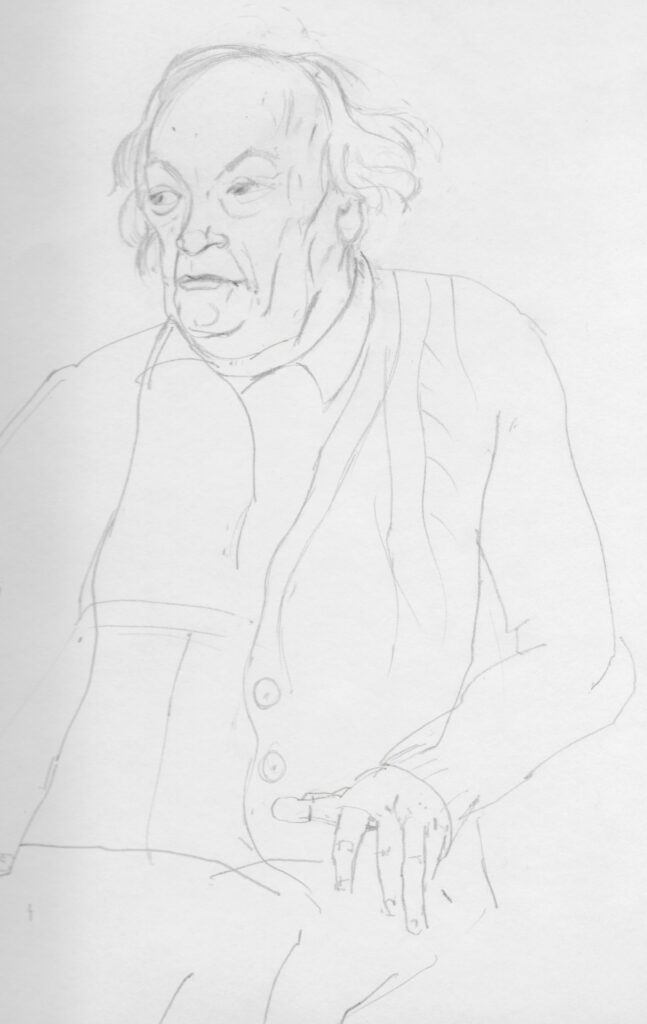
I continue to read Sally Magnusson book about her mother’s dementia. I read it in short bursts, at breakfast mainly, in between my frequent comings and goings, up and down the stairs making beds, sorting out the washing and other domestic tasks that I long to get done so that the day can stretch out uninterrupted. (It never does, by the way.) It’s a profoundly moving piece of writing. And the way she peppers her mother’s and her own story with scientific facts about what dementia does to the brain is chilling. How will it be to sit across from, to draw people with that condition? Can I ever truly understand what they are feeling? She writes of the fear, the disorientation, the torpor, the loss of self and all that was previously known and, indeed, loved. What are we without self, without direction, without knowing? How is it to care for someone who is lost to us, and themselves. I think of those I remember from the Home. The man who’d sit by the front door day in day out, coat and hat on longing to be taken out. Or the woman who was in the same place my father was at his end, the one I’d catch sight of on her bed, weeping softly and holding a teddy to her chest. It was truly pitiful. Where is grace to be found there? Is it all in the eye of the beholder?
Emerging from his room in the early hours needing a pee, he asked: “What’s the name of the butcher?” The day before he’d told me that he’d heard his number plate read out over the tannoy in Tescos, only to be told that some kind soul had noticed his car boot had been left open in the car park and informed Customer Services. He’s done it before. He says its because he presses the automatic key fob in his pocket by mistake and that opens it. Last time it was just forgetting. He’d walked off leaving it wide open. He is sanguine about it. And, in the whole scheme of things it is nothing, nothing. As is the drips of pee on the floor when he doesn’t quite make it to the loo in time. It is age, ageing and doddery-ness and I should be more forgiving and kinder. I try. After the event when I’ve been snappy and scratchy, I am. But I will try harder. I promise.
He went to the coffee shop without me. “I’ve sad news for you,” he said when he called to say where he was sitting and to tell me who he’d spoken to and who had made him his coffee. “The wedding is off,” he said, “Posh and Becks have split up, and apparently she’s going round telling everyone that he hit her.” I am sorry. They both deserve something like happiness. And it’s hard to be in a small town when something they’ve puffed up with hopes and dreams and all that fairytale detail is punctured. I am sorry for him mostly. But it doesn’t sound like anyone he spoke to was laughing. “It’s more likely that she hit him,” Jack Russell’s mum said.
They talked about the Queen’s Coronation in 1953. She was almost thirteen at the time, he was six. They had no TV, no one did back then, at least not here. So there were no moving pictures, no real focus, other than the ‘street-party’ that was held in someone’s garage. She remembered it being a dull day. Neither of them could remember what day of the week it was. Apparently someone gave her a coach and horses as a souvenir. She kept it for some time. They had jelly and sandwiches and the women of the street served them the food. He remembers the event through the photos he saw, and kept pouring over, in the magazines from the time. It seems that that was enough to cement it in his mind. And hers. I do like to hear them talk about such things. A life lived before me.
It was a gentle morning as I walked. No wind at all. I was tired and walked slowly, seeing things with more clarity, drinking it in. The lights around the marina, blue against the black, are a comfort in the still springtime morning dark. There were lights shining from a small fishing boat too. It was moored on the far side. I could see two men moving around and in and out of the boat. Perhaps they’d been fishing all night and were bringing in their catch. They worked in silence, companionable, knowing each other and the separate tasks they had to do, always did.