Categories
Writings

Ambergris & Sea Silk

DSCF0266

I called my aunt at the Home in Oslo. One second he said in Norwegian, I’ll go and get her. She took a while to come to the phone. I heard various clunking sounds and the noise of buttons being pressed. Halloo, halloo, she shouted. It’s me, I said. Oh, she said, that’s nice, before asking, you’re not in Norway are you? No, I said, why? It’s just I’m rather busy at the moment with a friend, she said, we’re staying at a rather nice place up in the Mountains. How lovely, I said, is the weather nice. Oh, yes, she said, lovely. I’m rather busy at the moment, she said, perhaps you could phone another time. Of course, I said. Of course. I think about you, I said. Pardon, she said, what did you say? I think about you, I said. That’s nice, she said, I think upon you too. Have a nice time, she said. Bye. Bye. Bye.

A day of radio stories. First a female voice talking about sea silk. There were tales of it being so fine that when spun into cloth it could be folded up and kept in a walnut shell, she said. Just like Donkeyskin, I thought, with her three dresses of the moon, sun and stars. And then another narrative about a man and his dog finding what he thought was ambergris on a beach. Sea gold. Oil from a sperm whale. Precious. Worth a fortune to a perfume maker. A great media furore follows – TV, radio and newspapers. It wasn’t ambergris. It was most likely palm oil, said a scientist, that had been in the sea for years. His dog dies of poisoning. The man becomes depressed until a friend brings him a new puppy. What did you do with the stuff? asks a reporter. Its under the sink, he replies. A reminder. Fool’s gold? Not he, he was sanguine throughout. It was the dog that found it and it killed it, he said. Best keep it so that it doesn’t happen again, eh?

The morning is heavy with a warm moistness, it makes me feel sleepy, groggy even. Crows caw outside my window.

I spent yesterday going through my slides. Neat little things. Old-fashioned now. But for some of my work that is all I have. A record of what I have done. What I have made. It was a good process. I felt richer for it. They hang now in other people’s spaces. In other people’s homes. Clearing is all I can do presently. And wait for something to come into the space. It will come. It will.


They gathered around the fishing boat. Indistinct figures in the morning dark. There was laughter amidst the silence and the thrum of the engine. A man and a young boy bounded out of a maroon van to stand against the wall and watch the sea. Not talking. Waiting.


Categories
Writings

Alarm Clock

Ellen Bell Call Me © Stephen Lynch Photography 064

Yesterday my alarm clock didn’t sound. I kept waking up to check the time. I thought it said 2.45 am but it was 9.15 pm. The second hand was twitching but not moving. It was caught, held fast, unable to make its journey around the clock face. So, I overslept. An hour and a half. It didn’t matter. Not really. Yet, I was thrown. Something had been lost. I couldn’t go on my walk. I couldn’t stretch my legs, take in the air, visit the sea. And I woke from a dream that I wouldn’t have had. Mum as a young woman, happier than I ever knew her in life. I’ll come round and collect my things, she said to me, smiling. Yes, I said, silently asking myself, what things? I don’t have anything of hers. I was wary of her brightness, her warmth, her lightness. Kitchen things? I asked. No, its a book, she said. In the dream she told me what the book was but on waking I forgot. What was it? What was it?

We bought a new clock. Nothing fancy, nothing digital, I said. Something old-fashioned. Something with a key and tick. It was a cheap repro thing. Fake gold. I would’ve preferred white or even red. It takes me a long time to get used to new machines. I approach them fearfully, warily. And I have little patience with instructions. I want to know them straightaway, to pass speedily through that sludgy period of unknowing.

All day I struggled with the loss of those 90 minutes. My routine had been upset. I was off-keel, lopsided, adrift. Grief seeps in. It finds the gap, that space in one’s usual optimism that is left unattended, unguarded. He went to watch the rugby with a friend and I walked. Alone on the prom in the sun. It was busy. He wouldn’t have liked it. North beach was chock-a-block. There was a steel band playing, the tinkety-tonk resonating across the sand. Next to them was a Punch and Judy booth, it’s curtains closed. The donkeys were out. An orthodox Jew boy was astride one of them, as I strode past, holding the reins nervously, his ringlets being jostled by the breeze. I pushed through the slow moving gluts of people queuing for ice-creams, or clustering around benches eating fish and chips out of turquoise-blue cardboard boxes. Turning round past the castle the crowds had dispersed a little. Some were on the beach, some in the sea, others queued or sat beside The Hut drinking coffee. I don’t mind the crowds as long as I could keep moving. I saw Sam’s ‘parents’. Sam the dog, that is. He always strokes him, always has ever since he was a pup. I don’t. I’m out of the habit. And shrink a little from the intimacy it engenders. They were sitting on the same bench, sans Sam. He doesn’t like the heat, they tell us, we’ve left ‘im at ‘ome. He thinks they’re having problems. See how they sit apart, he says, heads turning away. I don’t know, I say. This time they are closer together. We smile and greet each other though I don’t stop. I keep walking. Down to the Perygyl then back to the wall. To our seat. To sit in the sun and read.

I do read. The sun is hot. I take off my trousers. Who cares? Mrs de Winter by Susan Hill. I was intrigued by what she’d do with it. The story after Rebecca. It is a grey tale. And despite the sun, the greyness began to sink in. To penetrate. I didn’t think he’d notice. Why are you crying? he asked as I got into the car.

What can I say? It’s just old grief. Just old stuff. Some days it is fine. Other it is not. The second Mrs de Winter has nothing to do. She does nothing. They do nothing except drift across Europe moving from hotel to café. They talk, they do crosswords, they people-watch, they sit in the sun, they sleep and they grow old. She thinks too much, just as I do. Just live in the present, she commands herself. Accept, acquiesce and succumb. She has no ambition for herself – she just longs to be still and find home. And me? What do I want for myself?

It worked. The clock worked, though I had a back-up alarm set up just in case. It was a tringing sort of sound. I had my walk. A drizzly one. The bodies were about nevertheless. For they are just bodies at that time in the morning. Spent. They lurch, shout, or lean against walls staring at nothing. I watch as a couple kiss, melting into each other like a form by Munch. Another pair pass me, hands held awkwardly. Strangers a few hours ago. Later, two lads run down Great Darkgate Street singing. They are in cut-off jeans and t-shirts. The shirts made wet by the rain cling to their shoulder blades. Nice beanie, one of them calls out to me, before jumping on his friend’s back.

So what of today? Any better? Look at your feet, he tells me, just look at your feet. I remember the ‘little steps’. That’s what he used to say. Just little steps. The bigness of it all is too much. What can I do now, today? I want to sort it all out. Go through it all. Sloughing it off and getting to the nub. And what if there is no nub? Today I can cope with that. Yes.

Two magpies on the roof. Two for joy, I intone silently. Joy. He bringing me sweet peas wrapped in brown paper. And night-scented stocks in the blue jug. The Archers omnibus and a pot of strong coffee. I will look back to go forward. It is what I promised I would do. Need to do. Want to do. Clear the decks, make room for something. Something. New.

Categories
Writings

Settling

Ellen Bell Call Me © Stephen Lynch Photography 030

It’s been a while, hasn’t it? Since I wrote that is. I’ve moved. I think I told you. Not far, just up the road, actually. Our postcode is almost the same, just one letter different. A Q exchanged for an E. That’s all. I like it here. It is an airy space. We are up high. In a nest. And we can see the sea. The upstairs room makes we want to be a dancer.

Nevertheless, I am still a little discombobulated. Shaken up like the contents of one of those little snow scenes, where the flakes buzz about in the liquid before slowly sinking to the base. As a child I thought they were magical. And have not made anything meaningful. Not yet. The space is ready. My studio. My writing room. A capital E hangs on a nail on the door. Ready. Ready for what. I don’t know.

It is uncomfortable to not know but it doesn’t have to be. I needed the space first. Then I need to sit in it and wait. Look at the sky and wait. What harm? I have done work, you know, pot-boiling work. It’s OK – I like doing it but eventually the nagging voice always comes in. You know, why aren’t you doing something more…..more meaningful, more important, more emotive, more, more……what? I don’t know. I just don’t know.

We went to London to see the archives at LMU. I wanted to find authentic voices. Mothers’ voices. I was unsettled by all the procedures. Wall after wall of protocol. I felt out of control, under surveillance, unable to access what it was I was looking for. The documents I read were all dictated. Of course, how stupid, I should have known. Most of them would have been illiterate. They all began the same way, right through the 200-300 years of recording. ‘The first time I encountered the father…’ And then there followed tale after tale of seduction, forced sex and pleas for marriage and financial help. Moving though they were, there was little mention of the children. I was looking in the wrong place. You need to go back to the Foundling Hospital, she told me, begin again. The only personal thing I found was a Christmas card, stuck at the back of an envelope of legal papers. A card from a mother to her daughter. Poignant in its formality, its stiffness, it was addressed to a Miss ______ and signed Mrs ___________ wishing her a pleasant Christmastide. I remember such awkwardness, that uncertainty as to how to respond to the rituals of life, where to put myself. It was a frustrating expedition. London compensated. It always does.

Walking in the early morning, there was a dead badger on the side of the road. His carcass was virtually untouched. Was he just sleeping?

I think about collecting voices. Beginning with what excites me. Voices. The things people say. The things people say when they are trying to say something else. Or not.

I look for a little cabinet. A little wooden one with tiny shelves. I used to have one. I want to put my little treasures out. To look at them and wait for the burst of something like inspiration that they excite. Like my pictures, they are what has been and the road to what will be. Wait and see. Wait and see.

See.


Categories
Writings

White-ness

Ellen Bell MORDANT © Stephen Lynch Photography 053

In the morning……I can open my eyes to nothing but whiteness, writes Jenny Diski in Skating to Antarctica, a repetition of white when I raise my eyes. Morning moments of indescribable satisfaction. Eventually, I’ll have to let colours in to my day, but for a while I can wallow in a seemingly boundless expanse of white.

Stephen’s Lynch’s photographs of MORDANT are gorgeous. The white of the painted plaster looks like snow.

MORDANT space - Stephen Lynch (1)

Like Diski, I find complete white so restful – joyous even. There is nothing to disturb, just a blissful nothingness. An emptiness of white.

White. White and red. White, red and black. I remember writing about the symbolism of colours in my English Literature A Level exam. I think it was for Thomas Hardy’s Tess of the D’Urbervilles. The red of the strawberries that Alex drops into her mouth and the red of his blood as it drips through the boarding house floorboards. Red and white the colours of life and death.

It had been a good day. I’d finished painting the first two coats of white for MORDANT at Oriel Davies, Newtown. And I was just getting ready to get out the car when I felt it. A pin prick of something on my thigh. Then it began. The running of red. So fast. My trouser-leg soaked in red. It had been a scalpel blade that had come loose from its protective cover. Poking out of my cloth bag it stabbed my thigh. Red everywhere, even into my plimsolls. They turned a yellowy-pink in the washing-machine. My blood. My own personal dye. And more patches on my trousers. There are four now. I don’t want to let them go. You look good in them, he says. That’s enough. That’s enough reason.

In The Piano Harvey Keitel puts his finger into the hole in her black woollen stocking. So sexy. That detail of it. The revelation of flesh. Pink against black, soft against rough. Waiting for a massage, I watch as the receptionist bustles into the treatment room to prepare the bed. In and out she goes, carrying out hot stones and towels. Her hair is pulled hard off her face. She scowls a little. A busy little body of a woman. She wears black leggings and a black shiny tunic. Do you want to go in now and chill a little till Veronica is ready for you? she asks. Thanks, I say, I will. It’s nice to have a little time before, isn’t it, she says. Yes. Her leggings are very tight and there is a hole in the inner thigh. Does she know it’s there, I wonder.

Oh, I think I’ll just pootle a bit, she says. Pootle, I say. I like that word, I think I’ll borrow it. I love her voice. It’s soft and treacly. She says ‘don’t know nothing’ a lot. Oh, that’s my slang, she says. And I can hear her giggle. Is she happy? I hope so. I try to imagine what she looks like but in a way I don’t want to know. She is in my head. That’s enough. I look forward to our chats, she says. Me too, I reply and then ask myself if it is true. Sometimes, I don’t want to pick up the phone. Phones are an intrusion and I know she feels the same, for sometimes she doesn’t answer and I must wait another week to hear her. And yet, once I’ve done it, it is good. It is a good feeling. In the end it is about a connection. A connection with another being. There is a warmth in making one. One feels enlarged by it. I surrender to their lives, stepping out of my own, just a while. So, this is how it is to be you. Tell me, what is on your mind? Tell me, a little about your life. Will you? And I will listen. I will listen. I promise.

Categories
Writings

Made-up

Steve plastering (3)

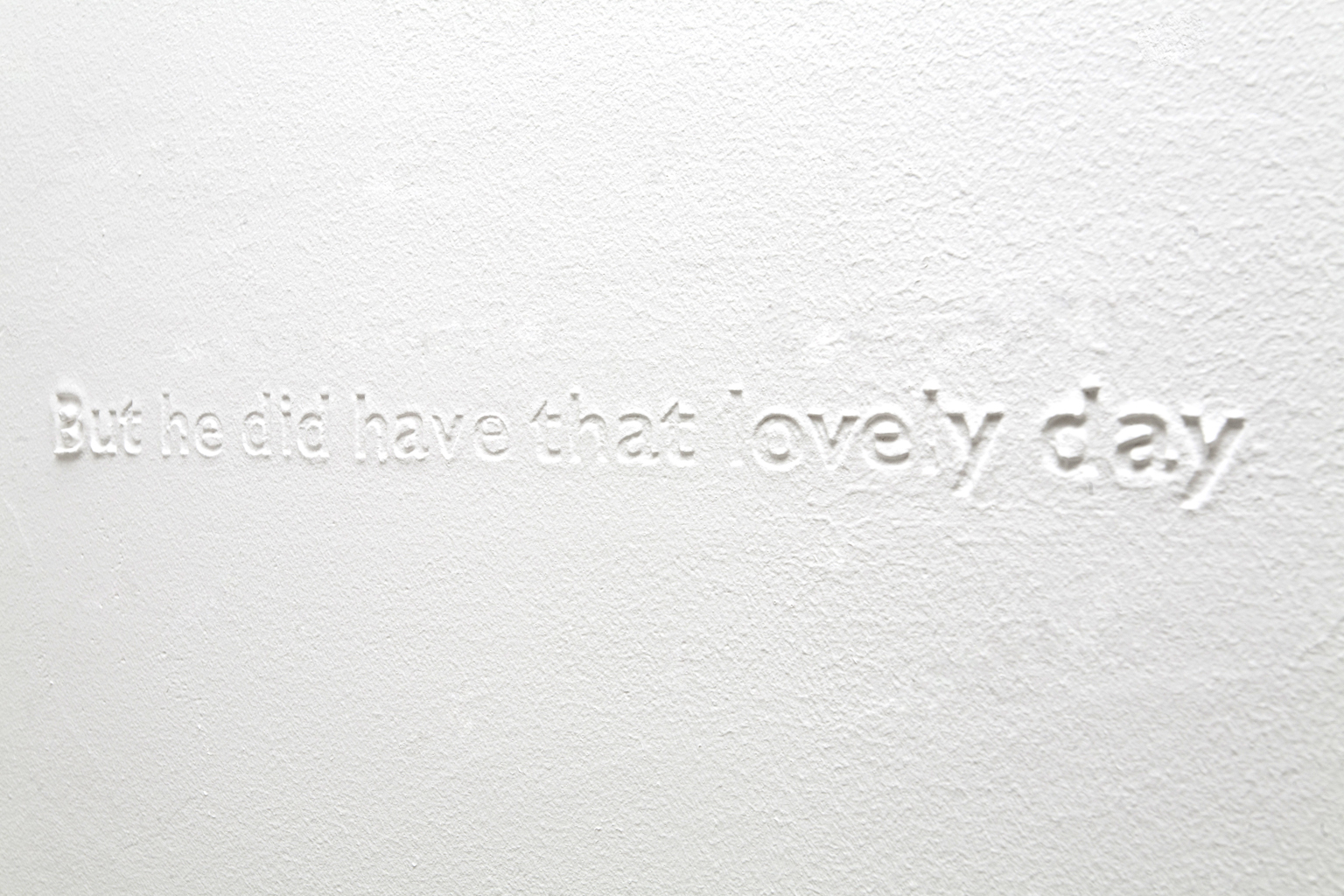
I was made-up seeing you, he said. Made-up. Made full. Completed. MORDANT is made. My little white room. I will hold it in me, forever. That little white space of light. Just light and those words, indistinct, barely there. You need to look close. Some may not see them. They may walk in and then walk out again. That’s fine. That’s as it should be. Art doesn’t have to be for everyone.

Ellen painting (7)

It looks beautiful. It has a been a happy project. I love its physicality. I love that fact that you can walk inside it. Be within it. I am hooked.

Drawing at ODG (1)

He wanted to know the context. Who talked about Clacton? I can’t remember. Does it matter? Yes. He has a story. His own story. His ex-wife was from Clacton. Its all about stories – other people’s stories that I seek so as to eclipse mine. We are all the same. That is the draw. Our sameness not our difference. The listening was a joy. It always is. That stopping of one’s own story so that one can encounter and sit within another’s.

She suffers from anxiety, though she never speaks of it in those terms. I ask if she goes out each day. Not every day, no, she replies, though most mornings I say hello to the postman. Words tumble out of her. We talk of church, of her daughter and how her hands hurt now when she makes welsh cakes. Though a friend got me this cream, she tells me, its herbal, and that helps. Not for long but for a while. That’s good, I say. That’s good. I called her darling, last time. I couldn’t help myself. It is her vulnerability it brings out the tenderness in me. Sometimes she laughs and that, well that, makes me up.


Categories
Writings

Flora

Wild flowers at ODG (5)

A patch of green. A small square of wildness, of weeds outside the gallery. Flora opened last night. The place was packed. It’s a strong show, an intelligent show. A celebration of flowers. Wear something floral, she said. I’ve always found private views uncomfortable. The art seems secondary somehow. I’m too impatient for all that standing around. Like at cocktail parties, fingers fondling wine glasses and all that incessant small talk. Sometimes one hears a gem but mostly it is nothing. A noise of nothing. The place was packed. That’s good, isn’t it? The highlight? Meeting Tom the artist. He was so chuffed about the review. It was a small thing. I loved writing it. It felt right and honest. He was touched. That’s good, isn’t it? And the other? The other highlight? Seeing them. My friends just there, across the room. What a surprise. They’d come all that way, just for me. What a delight. What a joy.


She’d just been brought back from being wheeled around the park. They were helping her out of the wheelchair when we arrived. She was screeching in pain. Then she stopped and turned to you, saying in Norwegian – I know you, you’re that film star, aren’t you? You didn’t understand. I translated and then she said it in English. She was still a beauty – ravishing. You were charming, as always. And then upstairs you charmed another.

It will be alright. It is always alright. There is no bogeyman. Just life, just life. I think about my little white room. Jenny Diski has one. What is it about white? My room is like a cloud, a misty space with no dark corners. Look closely and there are words. I think about my little room in the gallery. All shut up on a Sunday. Who goes in there now?

Categories
Writings

Readiness

MORDANT - publicity photograph - Ellen Bell (4)

I am in readiness. Ready. But. But life is never that simple. Or is it? I try to find my peace, inside. Let the fear go. That fear of the unknown, all those things that could, that could go wrong. Poor man, he sounded so shattered. Shattered by this not so simple life. Or perhaps it is that simple. Life and death. That’s what it is, just life and then death. First his father-in-law and now his mother-in-law. He is a gentle man, I believe, yet urgent with contained energy. I liked watching him work. A confident stroke as the plaster met the board. A sweep, sweep and it was smooth. We will take care of him if he comes. We will be kind. That, I promise. Let it be so.

Across the road is a steep bank of trees. It is left to do it own thing. A little patch of wildness. Rooks nest there, and yesterday afternoon there were two magpies collecting twigs. And there are blue tits. I hear their silvery rattling. In the morning I looked out of our kitchen window and saw something scurrying. A tiny thing. How is it that I saw it? How is it that it caught my attention? What was it? I peered closer, there wasn’t time to get my glasses. It scumbled along – a dum-de-dum sort of movement. Would it be humming? Perhaps. It must have been a hedgehog. Though there were no prickles. Could it be so? Baby hedgehogs are born bald according to Google. I watched it mesmerised. I wanted it to stay visible. A safe thing. A sweet thing. It moved slowly, lost in its business, fussing amongst the leaves. What does the earth smell of? A moment’s distraction. A moment’s intensity. I persuade myself of miracles.

All is ready. I fuss over straight lines. Let it go. All is ready. Breathe.

Categories
Writings

Munch’s Apples

marks on wall in Pain

I’m almost ready to press my words into the plaster. It feels like I am holding my breath. How will it be? All this preparation and it will be ten minutes in the making.

He used to throw us his apples over the fence, she said. Munch in his garden at Skoyen throwing apples to two young girls. She is ninety-four now. Was he nice? I asked. Oh, yes, she said, he was very kind. We were both so moved by his paintings, even more so when they were juxtaposed with van Gogh’s. And the letters. My heart caught in my chest. It stopped for a moment. There. There they were, van Gogh’s letters. I must have seen them before in Amsterdam but here they seemed more intimate, so close. His hand was small, close, intense. And Munch’s too – so expressive, so felt. Both romantics.

To write. Too right. I love this. I need this. To write. Soon. When the two shows are up and done. Then there will be space.

I am in love with a place. I am in love with being there with him. I am in love with him. I am in love.

Nasty rabbits. Nasty rabbits and a fox that walked back to the mainland across the ice. It was too much for him. He was lonely and the rabbits, she told us, were nasty.

He calls it Doris. The dolphin. Of course, there are more than one. Any sign of Doris? he asks. No, not today. Not today.

Let it be what it will be. I am satisfied.

I place the stocks in a vase. Tonight they will intoxicate with their scent.

Categories
Writings

Perfection

Ellen Bell: Photography by Simon Cook 01736 360041

I’ve been preparing the text, placing each little wooden letter onto a balsa wood strip. One by one. Letter by letter. So slowly, so perfectly.

And yet, it isn’t perfect. Not ever. It can’t be. Does it matter? he asks. Does it?

I think about my text drawings. The work that I make with old texts. Letterpress printed texts. I zoom in close. The ink has bled a little and the letters are misaligned. Just slightly. Minutely. And how I love such mishaps. They speak of something human, a breath, a distraction, something untoward. It is OK. The mistakes of others. Why not mine?

Such errors, such imperfections are the traces of presence – the potter’s fingerprint’s, the gardener’s footprint, the glassblower’s bubble – they capture a moment, a something unexpected.

Turn your world upside down, he said. So be it. Enough of this seeking perfection. Not in this life. Not now. Not ever. The best is good enough. Good enough.

The blossom is blown in the wind like confetti. He carries some into the flat on his shoe sole. I find it, a fleck of white.

An actor reads from Philip Glass’s autobiography, who in turn quotes John Cage on his Silences. Cage wanted to the audience to bring their own stories, their own sonic narratives to his piece. Rather like the artist who made an empty gallery his show. See, he said, here is the space for you to project your memories of exhibitions onto. Charlatan, they mumbled, just like the Emperor’s New Clothes, they whispered. Do you think so?

How good it was to have an opportunity to write about my show prior to opening. Here it is:

http://www.newwelshreview.com/article.php?id=987

It helps to clarify what I am trying to achieve, sort out the wheat from the chaff. Such experiences are generally internal ones, writing helps me to expunge, look afresh and value it all anew.

More white boxes. For that is what it shall be. A white box with the minute-est interruption of words. Peter Brook called it the empty space – minimalist theatre – beginning with nothing but a white vacancy for his ‘Dream’.


Come into my little white box and see what you can see.

Categories
Writings

Adventures

2013-05-25 05.54.38

You’ve had lots of adventures, he said. I know, I said, I know.

Even so there was still a little frisson. I can’t call it envy, for I am not envious, not at all. I am pleased for her, for them. For it is a brave thing to sell up and go abroad. And he is right. I have done the same thing many times. And each time was such a thrill. All that promise of newness – sometimes in the sun, sometimes not. I am a romantic and I yearn to travel. To be off. On an adventure.

He mustn’t worry, mustn’t fret. I am not unhappy. I do know that for all the thrill of being-off there is a that big comedown when one is landed. For all that stuff one is hoping to leave behind follows, in tow, like Robert Bly’s black bag. The inside is the same, wherever we are. So it is OK to be here. Yes, I thought as I sat on the bench in the sun watching a blackbird hop about in the long, impossibly green, grass, it is OK to be here. And yet, I celebrate their braveness, as I have celebrated my own. I remember a friend’s mother going to live in Greece. She didn’t have a house to sell. She had nothing. Before she died she was living in a caravan out there. I met her once and I liked her. A gentle woman, yet so vital, free even. She’d been married to a policeman. Leaving all that behind meant she could be herself. The inside, this time, made sense – finding peace, as it did, with the outside.

Simon Mayo interviewed someone about circuses. They are not what they used to be. England was famous for its animals, the man said. I remember. The elephants, the horses dressed-like ballerinas and the little dogs with ruffs walking on their hind legs pushing prams. Were there lions? The smell is what I remember most. The smell of animal sweat. Animal anxiety. Just like zoos. I used to find circuses unsettling. They were too manic, too fast. On the verge of hysteria. Are they better now that there are no animals? Do people still want to run away and join the circus? Simon Mayo asks his guest. Oh, yes, he said, I still get letters.

Where would you run away too? Not Italy, he said. No? I said. No, we’d go to Northern France, he said. Yes, I said, that would be lovely. When shall we go?